Case study · Industrial fastener manufacturing
P-Clips: a British B2B manufacturer that doesn't look like a British B2B manufacturer
A new B2B e-commerce site for Birmingham Specialities — built so a procurement buyer sees the engineering and certifications before the cookie banner loads.
- Client
- P-Clips by Birmingham Specialities
- Industry
- Industrial fastener manufacturing
- Project type
- E-commerce site + brand system
- Completed
- 2026
7
Industries the product spec is positioned for
3
Material grades stocked (mild steel, A2 304, A4 316)
5
Fixing-hole-size variants (M4–M14)
336
Salt-spray-test hours documented as evidence
The starting point
Birmingham Specialities makes rubber-lined P-clips. If you’ve never thought about P-clips — which is most people — they’re the small one-piece metal fasteners that hold cables, pipes and hoses in place inside everything from cars to trains to factory ceilings. The rubber lining stops vibration damage and corrosion. Birmingham Specialities have been making them in the UK since the company was registered in 1947.
The technical end of this product is genuinely impressive. The mild-steel version clears 336 hours in independent salt-spray testing — significantly higher than the very-cheap imported alternatives that have flooded the market over the past decade. The stainless versions (A2 304 and A4 316 grades) push that further. The EPDM rubber liner holds its flexibility from -40°C to +120°C. The clips are used in automotive, rail, marine, industrial, HVAC, and agricultural applications.
The challenge wasn’t the product. The product is excellent. The challenge was the website needing to convince a procurement buyer at a Tier-1 OEM that a small British manufacturer was the right call over the cheap competitor whose only advantage is the unit price line on the spreadsheet.
The brief, distilled into one sentence: make the engineering visible before the cookie banner loads.
This wasn’t a freelance client in the usual sense — Birmingham Specialities was inside the group of companies I worked across at the time, so the project came together through internal planning sessions rather than a competitive pitch. We aligned on scope and got started.
The audience problem
A consumer e-commerce site is usually selling something the buyer wants in an obvious way — clothes, electronics, food. The decision is fast, the trust threshold is low, the design can lean visual.
A B2B niche-product site is different. The buyer is usually a procurement or engineering specialist who is going to be personally responsible if the parts they specced underperform. They’re not buying for themselves — they’re buying for the company, and the worst possible outcome for them is a Monday morning where a part has failed and someone is asking “why did you choose the cheap supplier?”
That fear is what most B2B websites in this category miss completely. They focus on product features and friendly imagery, when what the buyer actually needs is evidence that buying from you won’t get them blamed.
The whole site is structured around that observation:
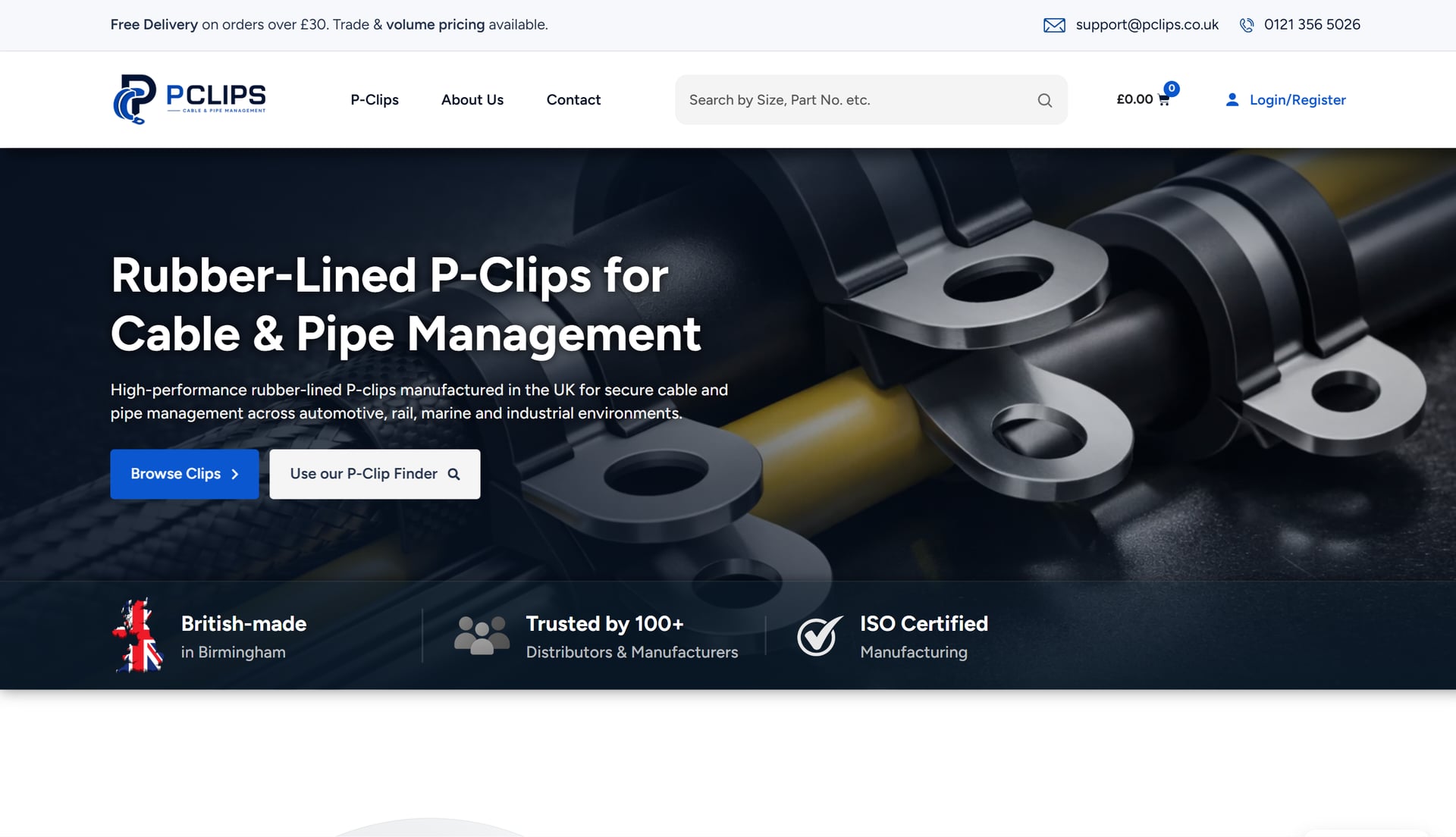
- The hero photograph is the product itself, in macro detail, with the rubber lining clearly visible. Not a smiling person in a hi-vis. Not a generic factory shot. The thing they’re actually buying.
- The headline is unambiguous about what it is and what it’s for: “Rubber-Lined P-Clips for Cable & Pipe Management.”
- The trust strip beneath the hero leads with three procurement-relevant signals: British-made in Birmingham · Trusted by 100+ Distributors & Manufacturers · ISO Certified.
- The independent salt-spray testing data is treated as a hero asset, not buried in a PDF.
A procurement reader can land on the page, get the value proposition in three seconds, see the trust signals in another five, and reach the product catalogue inside ten. That’s the whole job of the home page.
Architecting a B2B fastener catalogue
A surprisingly large share of the work on this build wasn’t the visual design — it was figuring out how to organise the product taxonomy so that a buyer with a specific job in mind can get to the right SKU in one or two clicks.
P-clips can be filtered by three dimensions:
- Material grade — Zinc-coated mild steel, A2/304 stainless steel, A4/316 stainless steel. Each suits a different environment, and the price escalates accordingly.
- Clip type — Standard rubber-lined, heavy-duty rubber-lined, and variants by industry application.
- Fixing-hole size — M4/M5, M6, M8, M10, M12/M14. This is usually the dimension the buyer already knows when they arrive on the site.
The navigation reflects this. P-Clips on the main menu opens a sub-navigation that lets the buyer pick on any of those three dimensions independently. A procurement officer who already knows they need M8 stainless 316 clips can get to the right product listing in two clicks — no hunting through generic categories.
The product detail pages then carry the technical detail the buyer needs to make the spec decision: dimensions table, material specification, testing data, downloadable spec sheets. None of which is exotic — it’s just present, which is more than half the competitor sites manage.
The “size, part number, etc.” search
One specific decision worth flagging: the primary search field on the site doesn’t say “Search products” — it says “Search by Size, Part No. etc.”
That’s a one-line piece of copy, and it changes the entire mental model the visitor brings to the site.
A search box that says “Search products” tells the visitor “we have a lot of stuff, you can browse”. A search box that says “Search by Size, Part No. etc.” tells the visitor “we know you already know what you need, here’s the fast lane.”
The B2B buyer who already has a part number from a previous order, or a size requirement from the engineering brief, doesn’t want to browse. They want to type the spec, hit enter, and be at the product page. That single piece of micro-copy makes their job five seconds faster — which on a recurring purchase is genuine value over the years.
The trust architecture
Trust on a B2B manufacturer’s site comes from a small number of specific signals, used precisely. Listing them all isn’t impressive — it dilutes. Picking the right three or four and giving them visual weight is.
The signals that earn their place on the P-Clips home page:
- British-made in Birmingham. The single strongest counter-positioning against cheap imports. The UK map icon plus the suburb name is concrete in a way that “Made in the UK” alone isn’t.
- Trusted by 100+ Distributors & Manufacturers. Quantified, plausible, specific to the audience. Not “trusted by businesses worldwide” — the actual category of customer (distributors and manufacturers) the visitor is likely to identify with.
- ISO Certified Manufacturing. Procurement teams require evidence of this. The certification is real, the badge is present, the wording is matter-of-fact.
- RoHS Certificate. Environmental compliance that European customers will need to verify before purchasing.
- Independent salt-spray testing. The salt-spray hours are the single most concrete differentiator vs cheap imports. The site treats them as a hero asset with comparison visuals, not as a footnote.
What deliberately isn’t on the home page: generic “customer satisfaction” claims, stock testimonials, vague “industry-leading” language. The visitor is a buyer, not a brand fan.
The account system the category usually doesn’t have
A traditional B2B fastener site treats commerce as an afterthought — typically a “call us for a quote” form, or a basic shop-and-checkout flow with no consideration of how recurring buyers actually use it.
P-Clips ships with a real account system: order tracking, saved delivery addresses, saved payment methods, bulk reorder shortcuts. A distributor placing a regular order doesn’t have to re-enter their delivery address every time. An OEM buyer ordering for a new project line doesn’t have to fight a clunky checkout to place a multi-line order.
The Royal Mail Tracked integration means orders ship the same day where possible and have proper tracking attached. Which sounds basic, but is uncommon enough in the niche-fastener category that it’s a genuine differentiator on the speed of the buyer’s job.
What’s under the bonnet
The site is built on WordPress, with Elementor as the page builder and a custom theme on top. The commerce side runs as a custom build rather than a stock WooCommerce shop, so the account features and ordering flows could be tuned to the specific patterns B2B fastener buyers actually use rather than the generic consumer e-commerce flow.
The stack reflects the constraints of the brief. WordPress was the right tool because Birmingham Specialities have internal staff who’ll need to update product specs, add new variants, and post to the resource centre without needing a developer every time. A modern static framework would have been faster but would have meant locking content edits behind a developer — not the right trade-off for this particular client.
Custom commerce features were built where the off-the-shelf WooCommerce flows didn’t quite fit how B2B buyers actually behave. The result is a site that looks bespoke without being unmaintainable.
What this case study is really about
Most British B2B manufacturers have websites that look like they were built once in 2014 and updated once a year. The cumulative effect is that British manufacturing — which is genuinely a competitive advantage on quality grounds against cheap imports — is digitally invisible at the point of procurement.
The P-Clips site is what it looks like when a small British manufacturer takes their digital presence seriously enough to compete at the procurement table on visual terms as well as product terms. The clip you’re buying is engineered. The website that sells it should be too.
Built with
- WordPress
- Elementor
- Custom e-commerce
- Royal Mail Tracked integration
Tags
- e-commerce
- manufacturing
- B2B
- UK
- industrial
- typography-led
More case studies
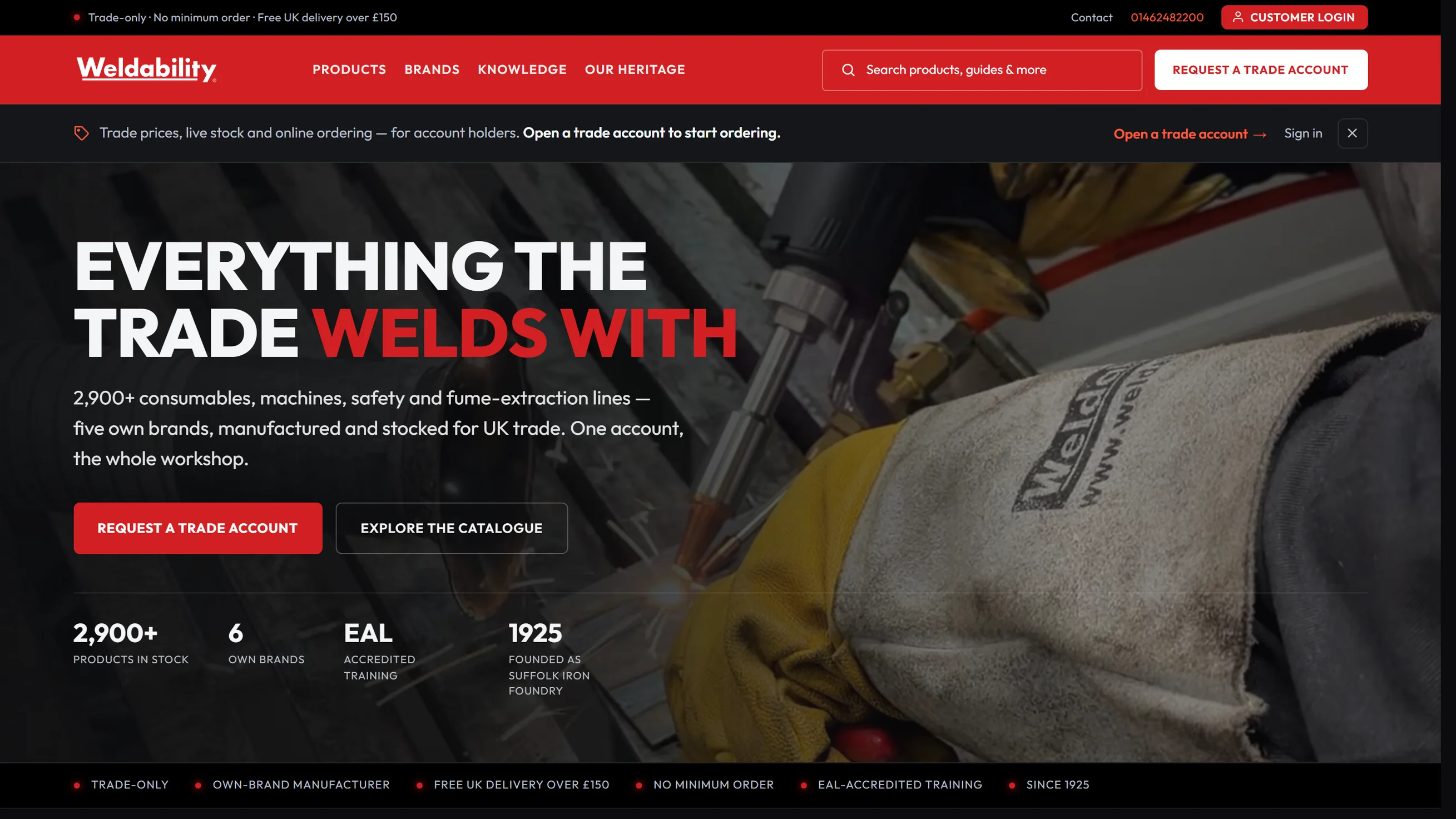
Welding supplies & equipment — trade wholesale
Weldability-SIF: taking a trade counter off the phone
A trade portal for a welding wholesaler founded in 1925 — 3,400 pages, contract pricing, credit and reordering pulled live from the ERP.
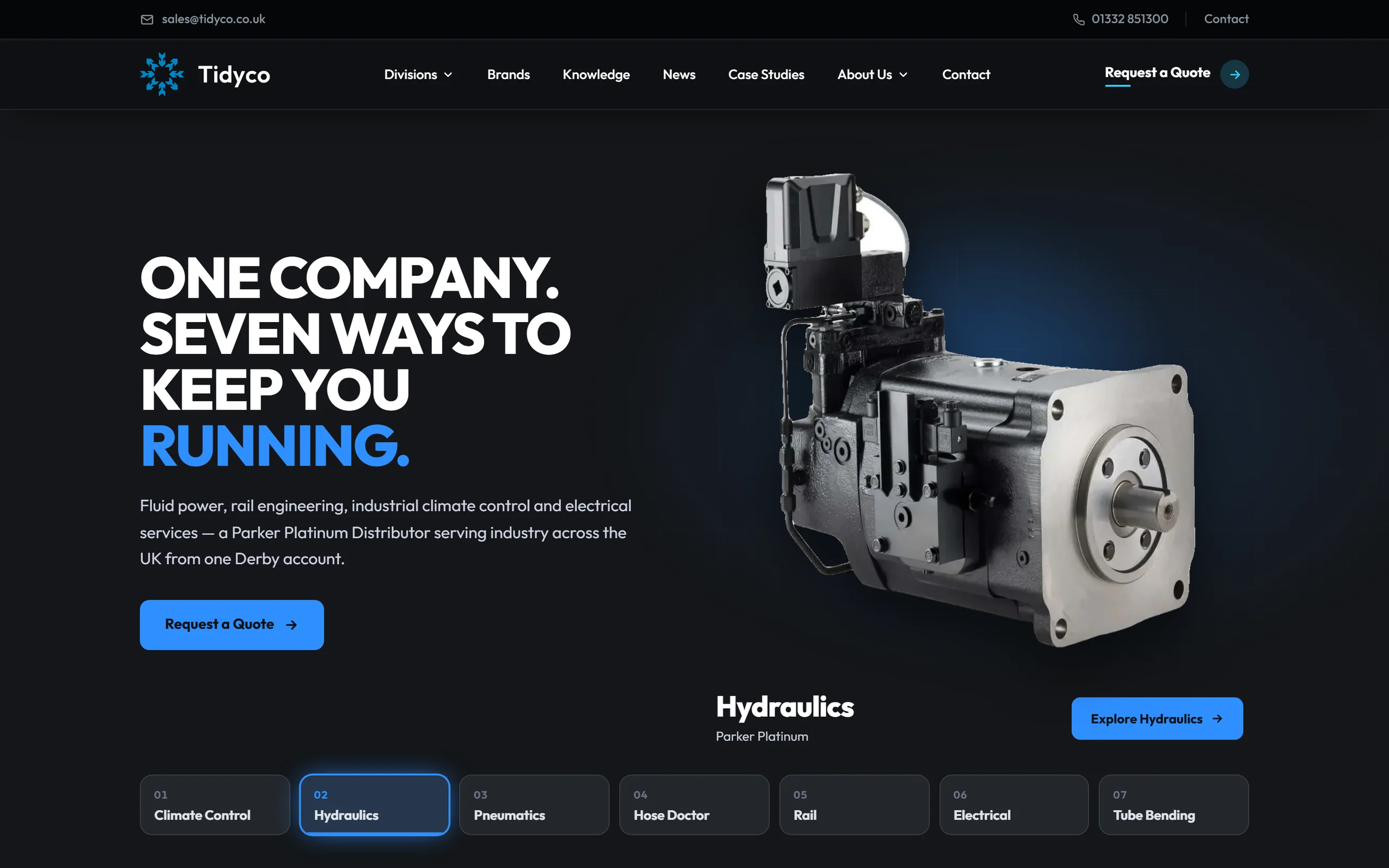
Industrial distribution & engineering services
Tidyco: seven divisions that stopped competing with each other
A rebuild for a Derby fluid-power and rail engineering group — seven divisions, one front door, and a 50-guide library that answers buyers before they enquire.
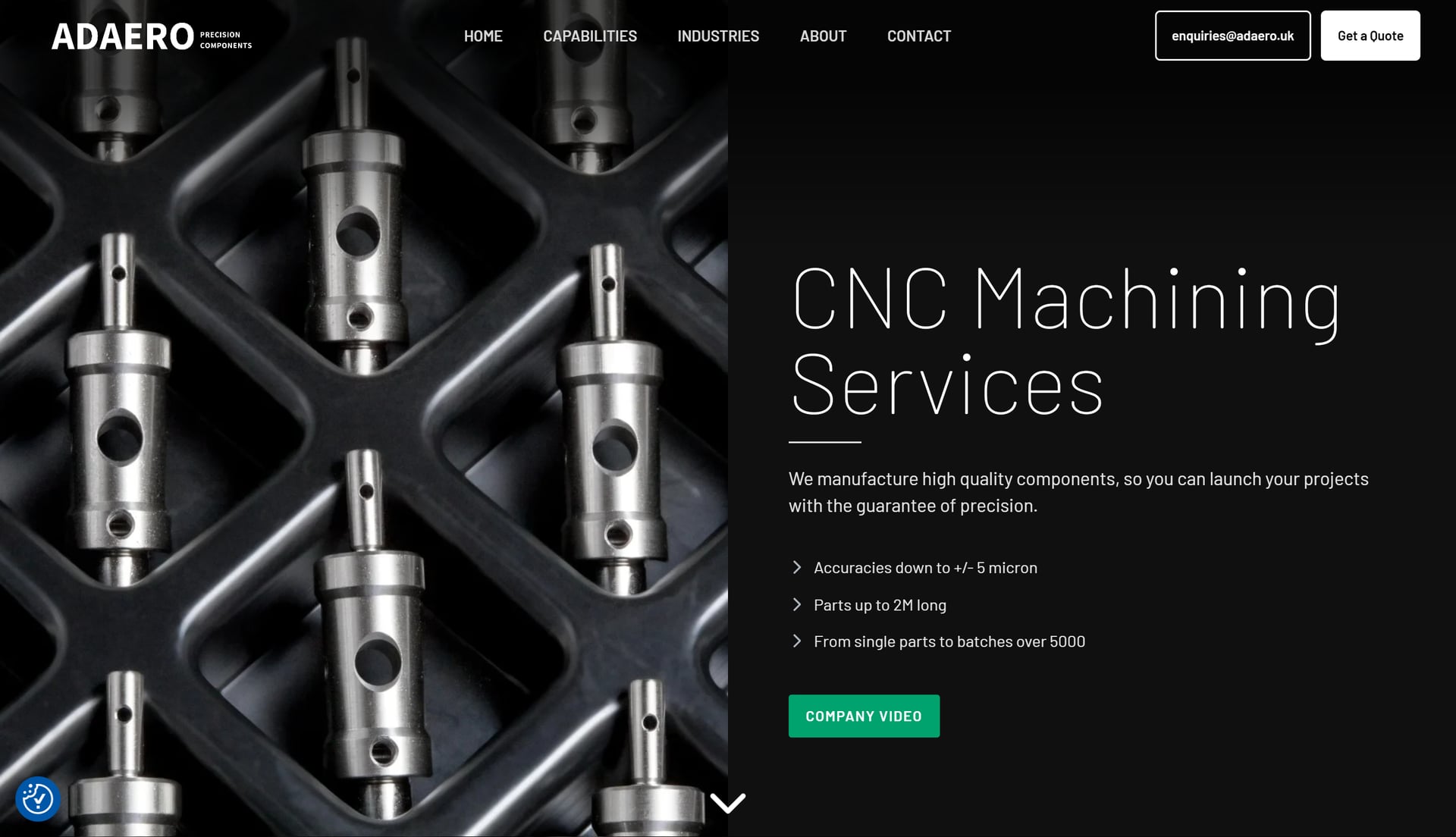
Precision CNC machining
Adaero Precision Components: a website as precise as the engineering
A new website for Adaero Precision Components, replacing a one-page brochure with a CNC machining presence that earns credibility at the procurement table.
Want results like this?
Let's talk about your site.
Fifteen minutes, no pressure. I'll walk through your current digital setup, where the leverage is, and whether what I do is the right fit for your business.